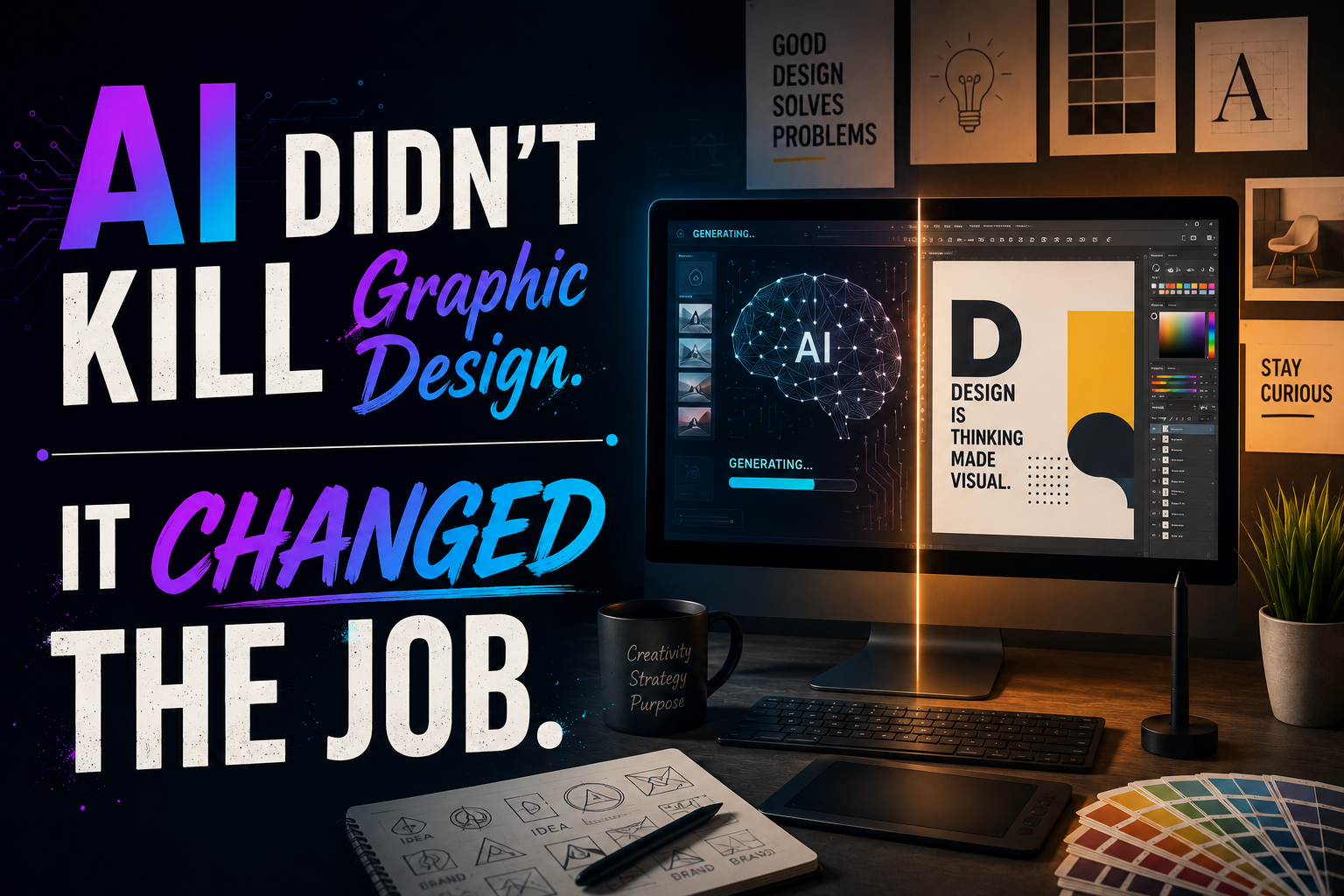
AI Didn't Kill Graphic Design. It Changed the Job.
When AI image generators first became widely available, many people predicted the end of graphic design.
Social media filled with headlines like:
"Graphic designers are finished."
"AI can create logos in seconds."
"No one will hire designers anymore."
Fast forward to 2026, and something interesting has happened.
Graphic designers still exist.
Businesses are still hiring designers.
Branding agencies are still growing.
Companies still invest thousands of dollars in visual identity projects.
So what changed?
The answer is simple:
AI didn't eliminate graphic design. It transformed what clients expect from designers.
Today, the most valuable designers aren't the ones who simply know the software—they're the ones who solve problems, think strategically, and know how to collaborate with AI rather than compete against it.
Why People Thought AI Would Replace Designers
The fear wasn't irrational.
AI can now:
- Generate logos in seconds.
- Create marketing visuals.
- Produce illustrations.
- Remove image backgrounds.
- Generate advertising concepts.
- Create social media graphics.
- Suggest layouts.
- Generate marketing copy.
Compared to the hours designers once spent creating these assets, AI feels almost magical.
But speed isn't the same as strategy.
What Clients Actually Pay Designers For
One of the biggest misconceptions about graphic design is that clients pay for visuals.
In reality, they pay for outcomes.
A startup doesn't ask for "a logo."
It asks for trust.
An e-commerce company doesn't ask for "a banner."
It wants more sales.
A restaurant doesn't ask for "a menu."
It wants customers to order confidently.
Graphic design is the tool.
Business results are the goal.
This is where human designers continue to create value.
AI Is Excellent at Execution
AI has become remarkably capable of handling repetitive and time-consuming tasks.
Designers can use it to:
- Generate mood boards.
- Explore multiple creative directions.
- Remove repetitive editing work.
- Create image variations.
- Generate copy ideas.
- Summarize client briefs.
- Speed up research.
These capabilities allow designers to spend less time on production and more time on creative thinking.
AI Still Struggles With Strategy
While AI can generate impressive visuals, it lacks genuine understanding of context.
It doesn't inherently know:
- Why a particular audience prefers one message over another.
- How a company's history should influence its visual identity.
- Which cultural references are appropriate.
- How a brand should evolve over time.
- The emotions a business wants to evoke.
Those decisions require human judgment.
The Skills That Matter More Than Ever
The rise of AI has increased the value of skills that machines can't easily replicate.
These include:
Strategic Thinking
Understanding business objectives before opening any design software.
Brand Building
Creating systems that communicate a company's personality consistently.
Storytelling
Helping businesses connect emotionally with their audience.
Communication
Explaining design decisions in a way clients understand.
Creative Direction
Choosing the best solution from many possibilities.
Critical Thinking
Evaluating AI-generated concepts instead of accepting the first result.
AI Has Changed the Designer's Workflow
Today's design process looks different from just a few years ago.
A modern workflow might include:
- Using AI to summarize the client's brief.
- Brainstorming concepts with AI.
- Generating mood boards and visual references.
- Refining layouts manually.
- Applying typography, spacing, and branding principles.
- Reviewing the work through a strategic lens.
- Presenting solutions backed by clear reasoning.
AI accelerates the process—but human expertise shapes the final outcome.
What Businesses Want in 2026
Increasingly, clients look for designers who can:
- Solve communication problems.
- Understand marketing goals.
- Build recognizable brands.
- Create consistent visual systems.
- Work efficiently with AI tools.
- Deliver thoughtful, strategic solutions.
The software you use matters less than the value you create.
The Biggest Mistake Designers Can Make
Some designers refuse to use AI.
Others rely on it entirely.
Neither approach is ideal.
The designers who will thrive are those who learn when to automate and when to think deeply.
Use AI to save time.
Use your experience to make better decisions.
A Practical Example
Imagine two designers receive the same brief for a wellness startup.
Designer A asks AI to generate a logo, picks one they like, changes the colors, and sends it to the client.
Designer B starts by researching the audience, understanding the brand values, identifying competitors, exploring concepts with AI, refining typography, testing layouts, and presenting a complete visual identity system with clear reasoning.
Both used AI.
Only one delivered a strategic solution.
That's the difference clients notice.
How to Future-Proof Your Design Career
To stay relevant, invest in skills that grow alongside technology:
- Learn branding and brand strategy.
- Improve your typography and layout fundamentals.
- Study marketing and consumer psychology.
- Master communication and presentation skills.
- Experiment with AI tools regularly.
- Build a portfolio that explains your thinking—not just your final designs.
The future belongs to designers who combine creativity with adaptability.
Frequently Asked Questions
Will AI replace graphic designers?
AI will automate parts of the design process, but businesses still need designers who understand strategy, branding, communication, and human behavior.
Is graphic design still a good career?
Yes. The role is evolving rather than disappearing. Designers who embrace AI while strengthening their strategic skills remain in high demand.
Which AI tools should graphic designers learn?
Explore tools that support ideation, image generation, editing, copywriting, and workflow automation. Focus on understanding how each tool fits into your creative process rather than trying every new platform.
What skills are most valuable in the AI era?
Brand strategy, storytelling, typography, creative direction, user psychology, communication, and the ability to evaluate and improve AI-generated work.
Final Thoughts
The conversation has shifted from "Will AI replace designers?" to "What kind of designer will succeed alongside AI?"
Technology has always changed creative industries. Desktop publishing changed print design. Digital tools changed illustration. The internet changed marketing. AI is the next chapter—not the final one.
The designers who continue to learn, think strategically, and put people at the center of their work won't become less valuable. They'll become more valuable because they'll know how to turn powerful tools into meaningful solutions.
AI didn't kill graphic design.
It simply changed the job.
Comments 0
Join the Conversation