For the last few years, the design industry has been divided into two camps.
One side believes artificial intelligence is destroying creativity.
The other believes AI will replace most designers within a few years.
Both conversations miss a much more important reality.
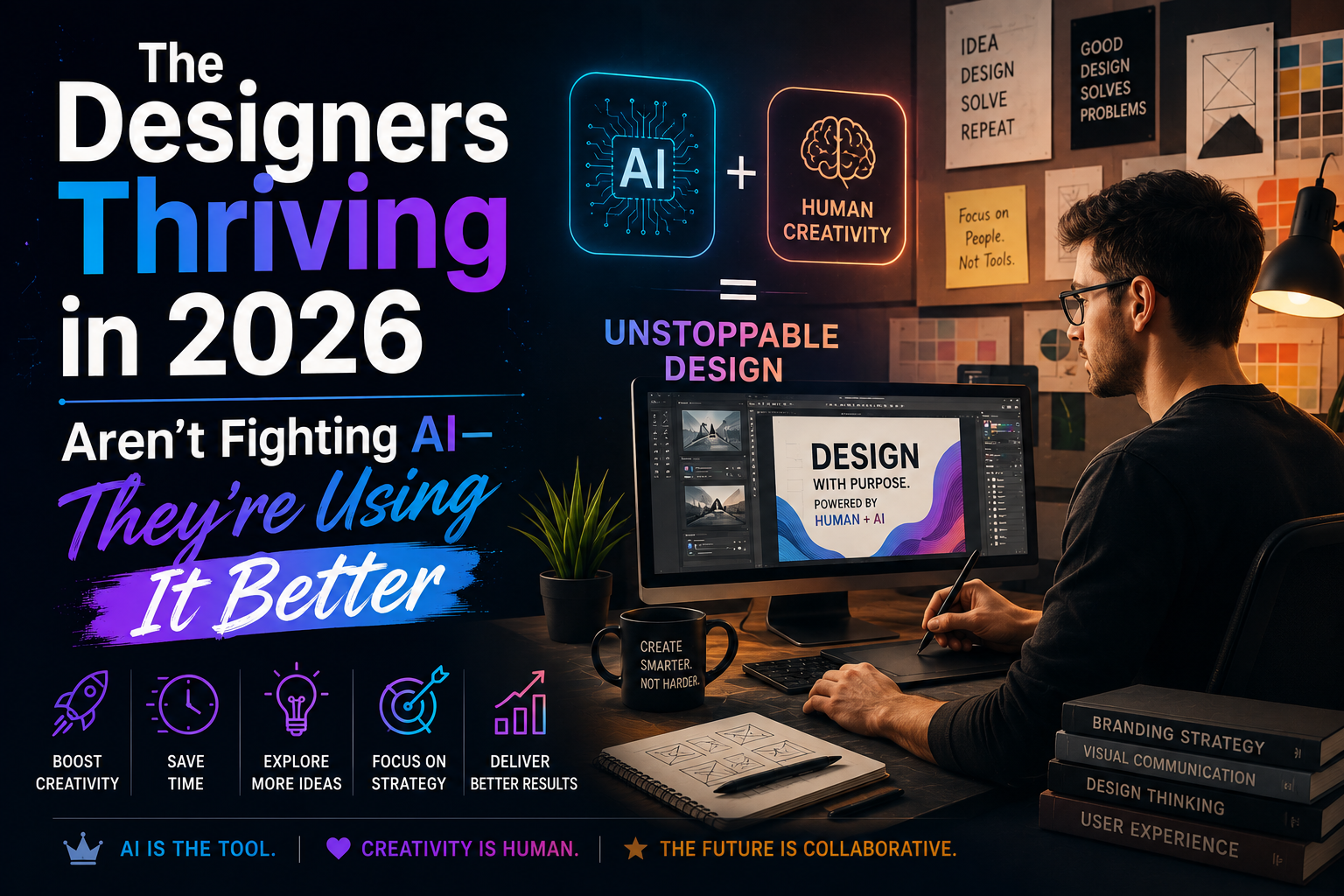
The designers building successful careers in 2026 aren't spending their time arguing about AI.
They're learning how to use it more effectively.
Instead of seeing AI as competition, they treat it as a creative partner—one that speeds up routine work while leaving the most valuable parts of design in human hands.
The question is no longer "Should designers use AI?"
The better question is:
"How can designers use AI to deliver more value?"
AI Didn't Replace Great Designers
AI has dramatically improved the speed of creative work.
Today, it can:
- Generate design concepts.
- Create illustrations.
- Suggest layouts.
- Remove backgrounds.
- Expand images.
- Produce marketing copy.
- Generate icons.
- Build wireframes.
- Create mockups.
Tasks that once required hours can now take minutes.
So why are experienced designers still in demand?
Because software has never been the product.
Thinking has always been the product.
The Difference Between Average Designers and High-Value Designers
Let's compare two designers.
Designer A
- Uses AI to generate a logo.
- Chooses the first option.
- Makes a few edits.
- Sends it to the client.
Designer B
- Studies the client's business.
- Researches competitors.
- Understands the target audience.
- Uses AI to explore dozens of creative directions.
- Refines typography and layouts manually.
- Tests different concepts.
- Explains every design decision.
Both designers used AI.
Only one solved the client's problem.
That's why businesses continue investing in skilled designers.
The Best Designers Use AI Throughout Their Workflow
Successful designers don't wait until the end of a project to use AI.
They integrate it into nearly every stage of the creative process.
Research
AI helps summarize industries, competitors, and customer insights.
Brainstorming
Instead of staring at a blank canvas, designers generate multiple directions quickly.
Mood Boards
AI creates visual inspiration that accelerates creative exploration.
Writing
Design presentations, case studies, and project documentation become faster.
Image Generation
Early concepts can be visualized before detailed execution begins.
Repetitive Tasks
Background removal, resizing, content-aware edits, and image cleanup take significantly less time.
AI becomes a productivity tool—not a replacement for creative judgment.
What AI Still Can't Do Well
AI has become incredibly capable, but it still lacks qualities that matter in professional design.
It cannot genuinely understand:
- Human emotions.
- Brand heritage.
- Long-term business strategy.
- Cultural nuance.
- Client relationships.
- Team collaboration.
- Creative intuition.
- Ethical judgment.
These are the areas where experienced designers continue to stand out.
The Skills Becoming More Valuable
As AI automates production work, human-centered skills become even more important.
Invest in developing:
Strategic Thinking
Design decisions should support business goals, not just visual trends.
Brand Strategy
A memorable brand is built through consistency, positioning, and purpose—not generated in one prompt.
Storytelling
People remember stories far longer than graphics alone.
Communication
Clients value designers who can explain the reasoning behind their work.
Critical Thinking
The ability to evaluate AI-generated ideas is becoming as important as creating them.
Curiosity
Technology evolves quickly. Designers who keep learning remain relevant.
Stop Measuring Your Value by Speed Alone
Many designers worry because AI is faster.
It is.
But speed isn't the only thing clients buy.
Imagine two architects.
One draws plans in one hour.
The other spends three days understanding the client's lifestyle before creating the perfect home.
Who delivers more value?
Design works the same way.
Clients remember outcomes—not production speed.
AI Should Give You More Time to Think
One of the biggest opportunities AI creates is time.
Instead of spending hours on repetitive production work, designers can focus on:
- Better concepts.
- Better storytelling.
- Better presentations.
- Better client communication.
- Better research.
- Better user experiences.
Ironically, AI makes human thinking even more valuable.
A Practical AI Workflow for Modern Designers
Here's an example workflow:
- Review the client brief.
- Use AI to summarize the project and identify key objectives.
- Generate mood board ideas.
- Explore visual concepts with AI.
- Sketch and refine manually.
- Apply typography, spacing, and branding principles.
- Test multiple variations.
- Present the strongest solution with clear strategic reasoning.
Notice something?
AI appears throughout the workflow—but it never replaces the designer's judgment.
The Designers Who Will Lead the Next Decade
The future belongs to professionals who combine three strengths:
Creativity
Generating original ideas and meaningful visual solutions.
Strategy
Understanding business, marketing, and customer psychology.
AI Literacy
Knowing when AI improves quality, speed, and efficiency—and when human expertise should take over.
Together, these skills create designers who are difficult to replace.
Frequently Asked Questions
Should graphic designers learn AI?
Yes. Understanding AI tools can improve efficiency and free up more time for strategic and creative work.
Will AI replace junior designers?
AI may automate some entry-level production tasks, but junior designers who build strong fundamentals, critical thinking, and communication skills can still grow into valuable creative professionals.
Which skill matters most in the AI era?
The ability to solve problems. Businesses don't hire designers simply to produce visuals—they hire them to achieve goals through effective communication and design.
How can I stay competitive as a designer?
Keep learning design fundamentals, understand branding and marketing, develop presentation skills, and make AI part of your workflow rather than your identity.
Final Thoughts
Every major technological shift has changed the design industry.
Desktop publishing changed print design.
The internet transformed marketing.
Smartphones reshaped user experience.
Now AI is reshaping creative workflows.
History shows that designers who adapt don't disappear—they evolve.
The professionals thriving in 2026 aren't winning because they know the most AI tools. They're succeeding because they combine technology with curiosity, empathy, strategic thinking, and a deep understanding of people.
AI can help you produce more work.
Only you can decide whether that work solves the right problem.
The designers who embrace that mindset won't spend the future competing with AI.
They'll spend it creating better work because of AI.
Comments 0
Join the Conversation