People form opinions about your brand within seconds.
Before they read your website...
Before they compare your prices...
Before they contact your business...
They've already judged your professionalism based on your visual identity.
That's the power of graphic design.
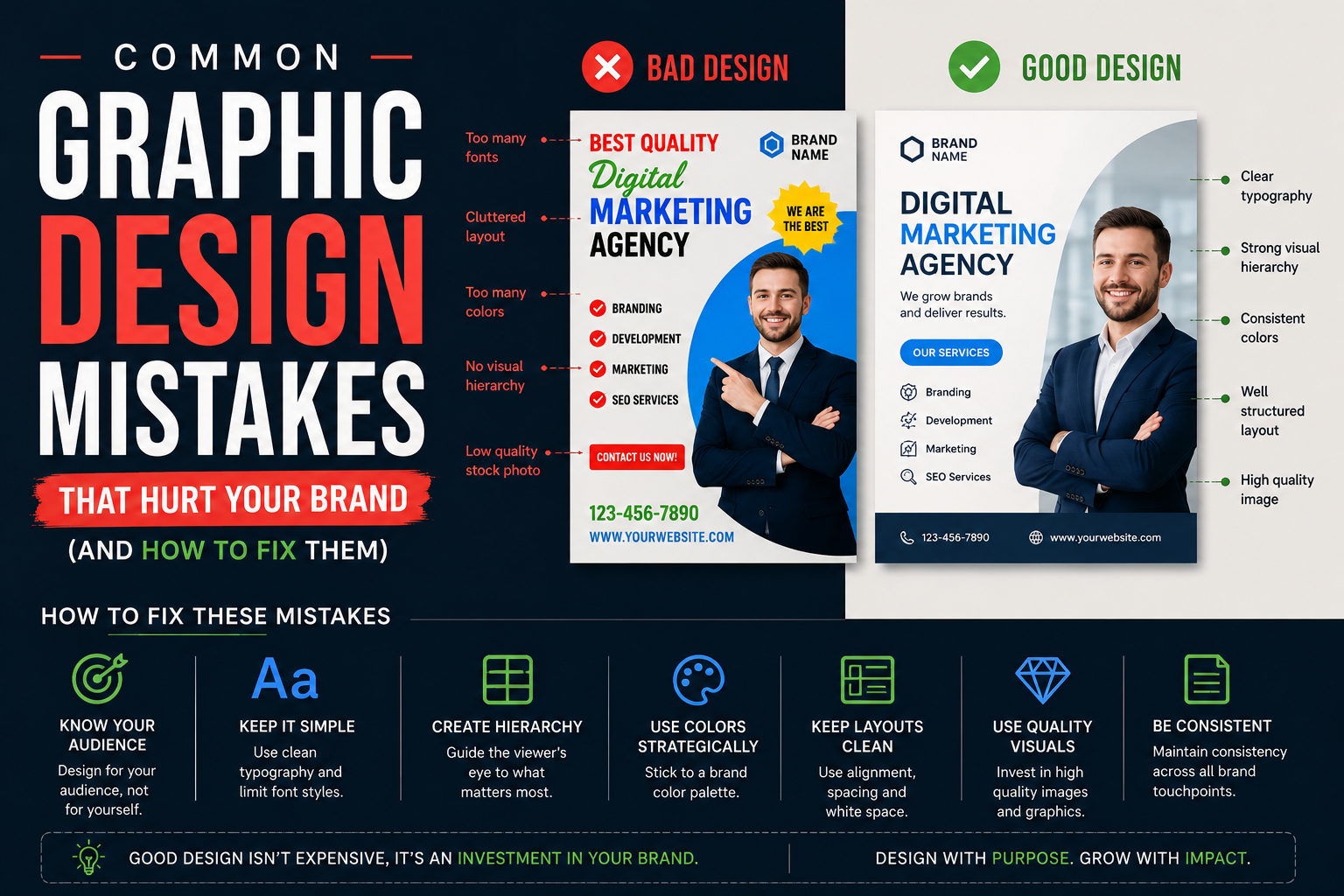
Unfortunately, many businesses unknowingly make design mistakes that reduce trust, confuse customers, and weaken their brand image.
In today's AI-powered world, creating graphics has become easier than ever. But creating a consistent, memorable, and strategic brand still requires thoughtful design decisions.
In this guide, we'll explore the most common graphic design mistakes that hurt your brand—and how to avoid them.
Why Good Design Matters More Than Ever
Consumers are exposed to thousands of visual messages every day.
To stand out, your brand needs more than attractive graphics.
It needs:
- Consistency
- Clarity
- Trust
- Recognition
- Purpose
Good design doesn't simply make a business look better.
It helps people remember you.
1. Inconsistent Branding
One of the fastest ways to confuse customers is inconsistent branding.
Common examples include:
- Different logo versions across platforms
- Multiple color palettes
- Changing typography frequently
- Different visual styles on every social media post
Customers should recognize your brand immediately, even before they read your name.
How to Fix It
Create a brand guideline that defines:
- Logo usage
- Brand colors
- Typography
- Photography style
- Icon style
- Layout rules
Consistency builds familiarity.
Familiarity builds trust.
2. Prioritizing Trends Over Brand Identity
Design trends come and go.
Brands stay for years.
Many businesses redesign everything simply because a trend becomes popular.
The result?
Their identity disappears.
How to Fix It
Use trends carefully.
Ask:
Does this support my brand or simply follow what's popular?
Timeless branding usually outperforms trendy branding in the long run.
3. Poor Typography
Typography influences readability more than almost any other design element.
Common mistakes include:
- Too many fonts
- Small text sizes
- Poor spacing
- Weak hierarchy
- Decorative fonts everywhere
If people struggle to read your message, they'll move on.
How to Fix It
Limit yourself to two font families.
Build a clear hierarchy using:
- Size
- Weight
- Spacing
- Contrast
Typography should guide the reader, not distract them.
4. Ignoring White Space
Many brands try to fit too much information into one design.
The result is clutter.
White space gives content room to breathe.
It improves:
- Readability
- Focus
- Premium perception
- User experience
How to Fix It
Don't fill every empty area.
Sometimes what you leave out is just as important as what you include.
5. Weak Color Choices
Colors influence how people perceive your brand.
Using random colors without strategy creates confusion.
Imagine a financial company using bright neon colors everywhere.
Would it communicate trust?
Probably not.
How to Fix It
Choose a primary brand palette and use it consistently.
Every color should support your personality and message.
6. Designing Without Understanding Your Audience
Design isn't about personal taste.
It's about communication.
A design that appeals to teenagers may not work for executives.
A luxury audience expects something very different from a budget-conscious audience.
How to Fix It
Research:
- Age
- Interests
- Goals
- Pain points
- Buying behavior
Design for your audience—not yourself.
7. Overusing AI Without Human Direction
AI has become an incredible design assistant.
But many businesses make the mistake of publishing AI-generated visuals without review.
Common problems include:
- Generic layouts
- Inconsistent branding
- Unrealistic imagery
- Poor typography
- Weak messaging
AI generates options.
Designers create solutions.
How to Fix It
Use AI to:
- Brainstorm
- Generate concepts
- Explore directions
- Save production time
Then apply human judgment, branding knowledge, and design principles before publishing.
8. Using Low-Quality Images
Blurry or stretched images reduce credibility instantly.
Customers often associate image quality with product quality.
How to Fix It
Use:
- Professional photography
- High-resolution visuals
- Consistent editing
- Original brand imagery whenever possible
9. Poor Visual Hierarchy
If everything looks important, nothing is important.
Customers should know exactly where to look first.
How to Fix It
Create hierarchy through:
- Size
- Contrast
- Placement
- Typography
- Spacing
Guide the viewer naturally.
10. Inconsistent Social Media Design
Many brands treat every social media post as a separate project.
As a result:
- Colors change.
- Fonts change.
- Layouts change.
- Illustration styles change.
Their feed lacks identity.
How to Fix It
Build reusable templates that maintain consistency while allowing creative flexibility.
11. Ignoring Accessibility
Design should work for everyone.
Common accessibility issues include:
- Low color contrast
- Tiny text
- Difficult-to-read fonts
- Poor button visibility
Accessible design improves usability for all users—not just those with disabilities.
12. Designing Without Business Goals
Some designs look impressive but fail to achieve results.
Always ask:
- What action should people take?
- What message should they remember?
- What problem does this design solve?
Beautiful visuals without purpose rarely drive business growth.
How AI Is Changing Branding
AI has made content creation dramatically faster.
Businesses can now create:
- Social media graphics
- Marketing visuals
- Product mockups
- Website concepts
- Presentation slides
in minutes.
But speed creates a new challenge.
If every business uses AI without a clear brand strategy, many begin to look the same.
This makes original thinking, storytelling, and consistent visual identity even more valuable.
The brands that stand out won't necessarily use the most AI.
They'll use AI with the most intention.
A Quick Brand Audit Checklist
Ask yourself:
- Is my logo used consistently?
- Do my colors remain the same across platforms?
- Is my typography readable?
- Does every design look like it belongs to the same brand?
- Is the message clear within a few seconds?
- Are my visuals high quality?
- Does my design support my business goals?
- Am I using AI to improve quality—not just increase quantity?
If you answered "no" to several questions, your brand may benefit from a design refresh.
Frequently Asked Questions
Why is graphic design important for branding?
Graphic design shapes first impressions, improves recognition, communicates professionalism, and helps customers remember your business.
Can AI create a complete brand identity?
AI can generate ideas and visual assets, but effective branding requires strategic thinking, audience research, consistency, and long-term planning—areas where human expertise remains essential.
What's the biggest design mistake businesses make?
Inconsistent branding. When logos, colors, typography, and layouts vary across platforms, customers struggle to recognize and trust the brand.
How often should a business update its branding?
Minor refinements can happen as needed, but a complete rebrand should be driven by business strategy, audience changes, or market positioning rather than design trends alone.
Final Thoughts
A strong brand isn't built through one great logo or one successful social media post. It's built through hundreds of consistent visual interactions that reinforce the same message over time.
As AI continues to make design faster and more accessible, businesses have an incredible opportunity to create content at scale. But speed alone won't build trust. Consistency, clarity, and strategic thinking still separate memorable brands from forgettable ones.
Every design your audience sees—whether it's a website banner, an Instagram post, or product packaging, is a chance to strengthen or weaken your brand. The businesses that succeed won't be the ones producing the most visuals. They'll be the ones producing visuals with purpose.
Avoid these common mistakes, combine AI with thoughtful design principles, and your brand will stand out for the right reasons.
Comments 0
Join the Conversation